We utilize essential cookies to ensure our website operates effectively and remains secure. Additionally, we'd like to request your permission to use optional cookies. These are intended to enhance your browsing experience by offering personalized content, displaying advertisements that are relevant to you, and helping us to further refine our website.
Choose "Accept all cookies" to agree to the use of both essential and optional cookies. Alternatively, select "Let me see" to customize your preferences.
Privacy Preference Centre
Our website utilizes cookies to enhance your browsing experience and to present you with content tailored to your preferences on this device and browser. Below, you will find detailed information about the function of cookies, enabling you to make informed choices about which cookies you wish to accept. Please note that disabling certain cookies might impact your user experience on our site. It's important to remember that cookie preferences need to be set individually for each device and browser you use. Clearing your browser's cache may also remove your cookie settings. You have the freedom to modify your cookie preferences at any point in the future.
For a comprehensive understanding of our use of cookies, please refer to our complete cookies policy.
These cookies are needed for the website to work and for us to fulfil our contractual obligations. This means they can't be switched off. They enable essential functionality such as security, accessibility and live chat support. They also help us to detect and prevent fraud. You can set your browser to block or alert you about these cookies, but it means some parts of the site won't work.
Performance and Analytics
These cookies allow us to measure and improve the performance of our site. They help us to know how popular pages are, and to see how visitors move around the site. If you don't allow these cookies, we won't know when you've visited our site, and we won't be able to monitor its performance.
Functional
These cookies enable us to provide enhanced functionality and personalisation. They may be set by us or by third party providers whose services we've added to our pages. If you don't allow these cookies, some or all of these services may not work properly.
Advertising
These cookies collect information about your browsing habits to show you personalised adverts. They may be used to build a profile of your interests and show you relevant adverts on other sites. They don't store directly personal information, but are based on uniquely identifying your browser and internet device. If you don't allow these cookies, the adverts you see will be less relevant.
According to a survey by Supertouch®, 49% of workers only look to replace boots once they are ‘worn out’. Worryingly, this could be dramatically reducing the protective qualities of the safety shoes, making them unfit for use and increasing the risk of injury. We therefore recommend replacing boots if there is any damage to toe caps, fastening systems or once the sole grips have worn away by 50%. In order to ensure they are in tip-top condition during this time, it’s important to also store and maintain them correctly.
#1 Check Them!
Conduct regular checks. Everyone wears shoes and boots differently, which can result in uneven wear. Over time, this can affect the sturdiness of the shoe, its slip resistance, electrical shock resistance and crucially the comfort. Look for tell-tale signs of deterioration such as dents, wear patterns on the sole, rips, or tears.
#2 Dry Storage
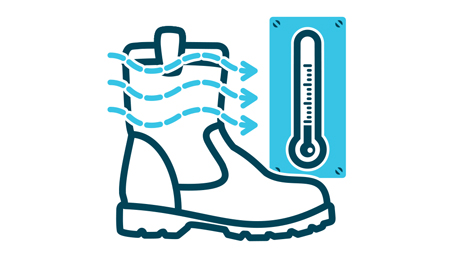
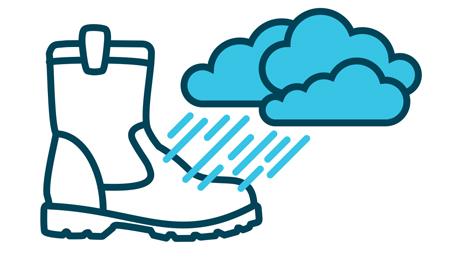
Avoid storing boots and shoes in damp areas. This can cause the boots to develop mould and under these conditions, the material in the shoes can breakdown, which can in turn damage the protective properties, such as water-resistant performance. Keep them in a cool, dry area that is well-ventilated instead.
#3 Water Damage
If wet, remember to dry boots out thoroughly far from direct heat and remove laces individually so they don't become brittle.
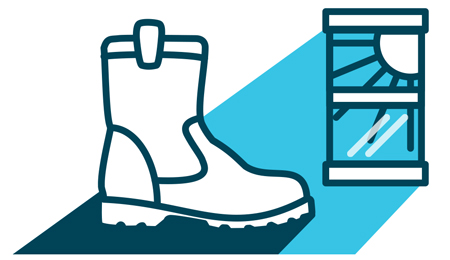
#4 Avoid Sunlight
Avoid excessive exposure to sunlight, as this can cause materials to deteriorate. Leaving them on the dashboard of a car or van can compromise safety performance.
To ensure correct specification and reduce the risk of the wearer removing their glasses, consider the following tips 1. Environment First and foremost, start by assessing exactly what the risks are in the working environment. This will help to narrow down the potential eyewear options by determining whether you need to choose a goggle style, or a spectacle style. Depending...
Setting the Standard Once the shoe has been appropriately matched to the environment, checking the relevant protection standards and overall fit for the wearer should be the next consideration. To ensure only the fittest footwear is selected, there are a variety of safety classifications and codes to consider during the specification process. BS EN ISO 20345:2011 is the current standard...
Despite being one of the most preventable workplace accidents, the Health and Safety Executive (HSE) found that slips and trips are the most common cause of injuries to employees. Research also conducted by the HSE found that these slips and trips cost UK businesses a staggering £500m a year in injury claims, investigation time, production delays and plant damage. But...